SShortSingh.
Back to feed

Giant Iceberg Drifts Over 1,000 km South Through Denmark Strait

0
·1 views
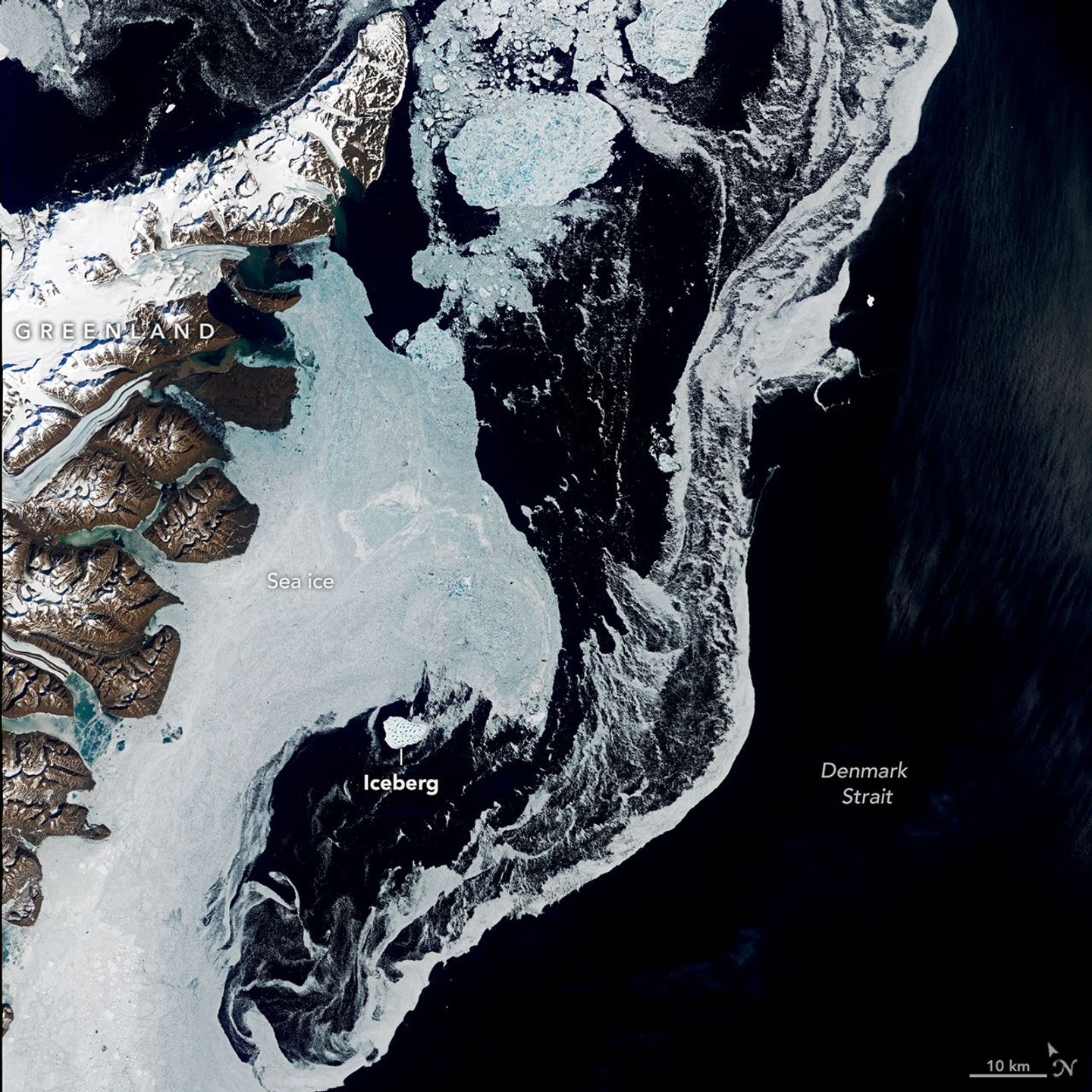
A large iceberg was observed in the Denmark Strait during summer 2026, having traveled more than 1,000 kilometers from its likely point of origin. The iceberg is believed to have broken off from a bay in northeastern Greenland before making its lengthy southward journey. Such an extensive drift is considered uncommon for icebergs in this region. NASA documented the event, highlighting the iceberg's unusual displacement from its source.

Read the full story at NASA

This is an AI-generated summary. ShortSingh links to the original source for the complete article.

Discussion (0)

Log in to join the discussion and vote.

Log in

Related stories

0
SpaceNASA ·

NASA Runs Terminal Countdown Simulation for Artemis III at Kennedy Space Center

NASA conducted a terminal countdown simulation for the Artemis III mission on Thursday, August 6, 2026, at Kennedy Space Center in Florida. The exercise took place inside the Rocco A. Petrone Launch Control Center, a key facility for managing launch operations. During the simulation, a jacket displaying Artemis I and II mission patches, along with other NASA insignia, was visible on a chair inside the center. Terminal countdown simulations are standard practice used by NASA to prepare ground teams for actual launch sequences. The Artemis III mission is part of NASA's broader Artemis program aimed at returning humans to the Moon.

0
SpaceNASA ·

NASA Picks Four University Teams to Drive Next-Gen Aviation Research

NASA has selected four university teams under its University Leadership Initiative to support the agency's aeronautics research goals. The program gives students the opportunity to contribute to real-world flight research projects. The selected teams will work on a range of topics, including high-supersonic propulsion systems and low-noise flight routes for small urban aircraft. The initiative is designed to advance NASA's broader mission to transform the future of aviation.

0
SpaceNASA ·

Gemini Experiments Tested How Well Astronauts Could See Earth From Orbit

NASA astronaut L. Gordon Cooper Jr. captured 29 color photographs of Earth using a 70mm camera during the Mercury-Atlas 9 mission in May 1963. Flying aboard his Faith 7 spacecraft, Cooper reported remarkably sharp visual observations from orbit, including vehicles on dirt roads and smoke-emitting trains. His accounts raised scientific interest in understanding the limits of human visual acuity in space. These observations laid the groundwork for formal visual acuity experiments that would follow during the later Gemini program.

0
SpaceNASA ·

NASA Earth Data Powers ML River Forecasts Amid Washington Snow Drought

NASA Earth science data is being used to support machine-learning models that forecast river conditions in Washington state. These forecasts help authorities make informed decisions related to water supply, electricity generation, and public safety. The initiative comes as the effects of a prolonged snow drought continue to affect the region. Reduced snowpack can significantly impact river flows, making accurate forecasting critical for resource management. The collaboration highlights how satellite-derived data can be applied to address real-world environmental challenges.

Giant Iceberg Drifts Over 1,000 km South Through Denmark Strait · ShortSingh