SShortSingh.
Back to feed

Webb Telescope Captures Largest Image Yet of Star-Forming Region IC 348

0
·64 views
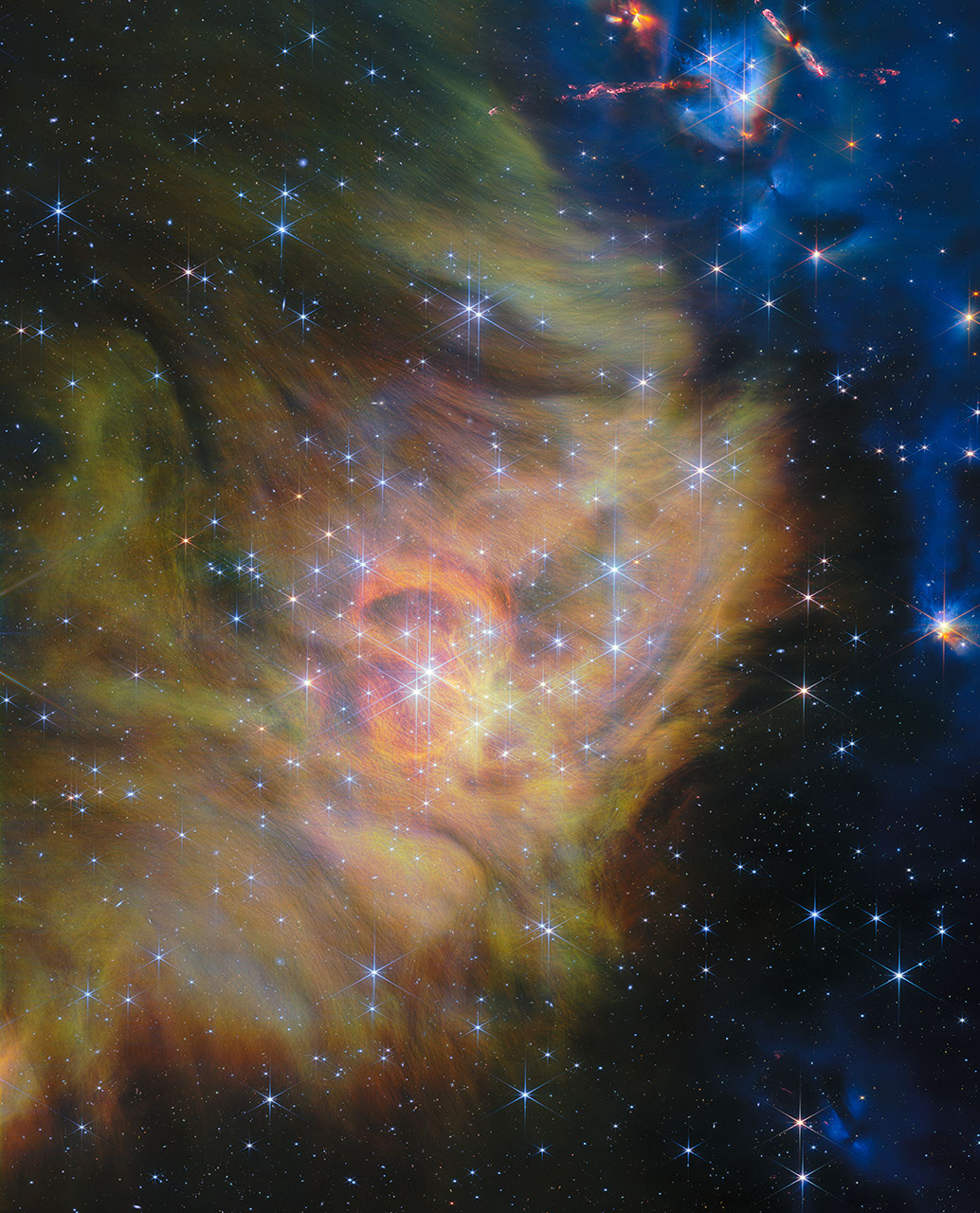
NASA's James Webb Space Telescope has released one of its largest images to date, capturing the nearby star-forming region IC 348. Astronomers used the telescope to search the region for brown dwarfs, which are celestial objects less massive than the smallest stars. The research team successfully identified brown dwarfs with masses as low as just twice that of Jupiter. The discovery pushes the boundaries of what scientists can detect in star-forming regions and offers new insights into the formation of low-mass celestial bodies.

Read the full story at NASA

This is an AI-generated summary. ShortSingh links to the original source for the complete article.

Discussion (0)

Log in to join the discussion and vote.

Log in

Related stories

0
SpaceNASA ·

NASA Unveils X-70 Fractal Experimental Aircraft for Flight Research

On Wednesday, NASA revealed its newest experimental aircraft, the X-70 Fractal, at the UP.Summit held at the Kennedy Space Center in Florida. The crewed platform is built to be highly adaptable and high-performing, intended to speed up the development and testing of advanced aviation technologies. A key feature is its rapidly reconfigurable flight-control system, which gives researchers new ways to explore flight dynamics. The aircraft is positioned as a tool for accelerating aviation innovation within NASA's research program. The remainder of the original article was truncated, so further details are not covered here.

0
SpaceNASA ·

NASA Outlines Plan to Speed Up Artemis and Return Americans to the Moon by 2028

On October 23, NASA Administrator Jared Isaacman and other agency leaders presented an update on the agency's strategy for returning Americans to the lunar surface. They detailed progress on previously announced plans to accelerate the Artemis program. The timeline targets an Artemis III test flight in 2027, with a crewed Moon landing following. The update reaffirms the goal of putting Americans back on the Moon in 2028.

0
SpaceNASA ·

NASA Selects Three Companies for Ka-Band Space Relay Communication Concepts

NASA has chosen three companies to develop concepts for Ka-band space relay capabilities. The work aims to keep existing spacecraft connected without requiring any changes to their onboard systems. The effort seeks end-to-end solutions spanning space and ground segments, launch, operations, and integration. The selections were announced on a Wednesday, though the article excerpt does not specify the exact date.

0
SpaceNASA ·

NASA Tests Autonomous Landing Tech on Drone, Showing Promise for Planetary Missions

NASA has shown that its technology can help spacecraft navigate on their own to safe landing spots on the Moon and other planets. On August 27, an Alta-X drone fitted with the agency's SPLICE guidance, navigation, and control payload carried out simulated lunar descent and landing maneuvers. The test demonstrates a capability intended to let future landers avoid hazards without relying entirely on ground control. The results point to potential improvements in precision landings for upcoming planetary missions.