SShortSingh.
Back to feed

NASA Astronaut Jessica Watkins Prepares Cell-Ink Samples for Space Bioprinting

0
·1 views
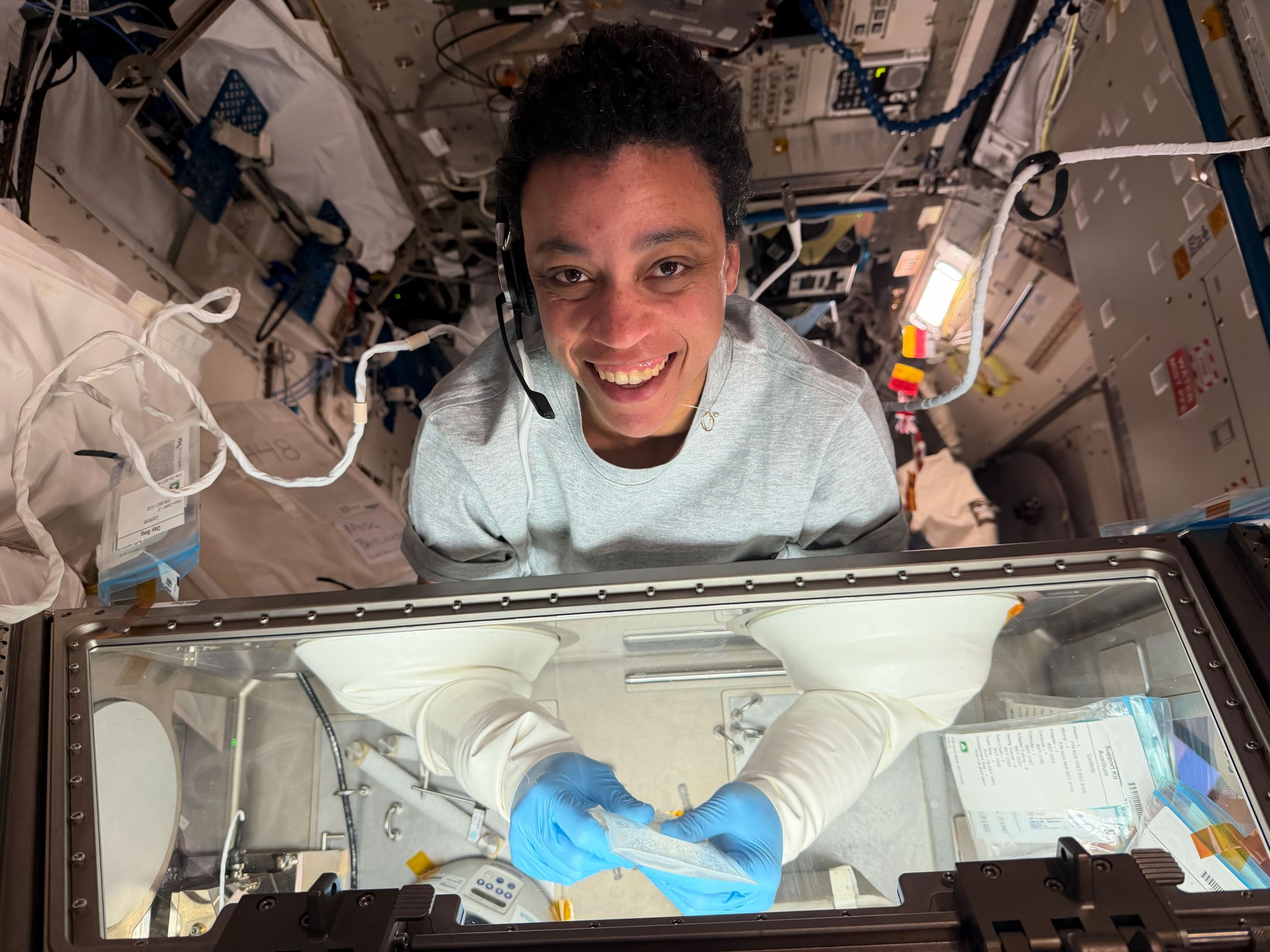
NASA astronaut Jessica Watkins, serving as a flight engineer on Expedition 75, worked aboard the International Space Station on October 9, 2026. Inside the Kibo laboratory module's Life Science Glovebox, she safely combined living cell samples with a bioink. She then loaded the cell-ink mixture into a specialized cartridge. These operations formed part of the InSPA-Auxilium Bioprinter-Cell Printing investigation, which examines 3D bioprinting in microgravity.

Read the full story at NASA

This is an AI-generated summary. ShortSingh links to the original source for the complete article.
Discussion (0)

Log in to join the discussion and vote.

Log in

Related stories

0
SpaceNASA ·

NASA's CASALS Instrument Aims to Fill Gaps in 3D Maps of Earth's Surface

Current space-based laser instruments collect Earth's forest and terrain measurements only along narrow lines, leaving vast areas unmeasured. Millions of acres of land therefore remain without direct scientific observation. NASA's CASALS instrument is designed to address this limitation by pairing machine learning with a compact lidar system. The combination would allow the instrument to adaptively sweep across large sections of the planet's surface. The approach is intended to produce more complete three-dimensional maps of Earth's terrain and vegetation.

0
SpaceNASA ·

NASA's APOD Highlights New Ghostly Structures Revealed in Cassiopeia

NASA's Astronomy Picture of the Day for October 21, 2026, features newly revealed faint structures in the constellation Cassiopeia. The image is part of NASA's daily APOD series, which pairs one cosmic photograph with a brief explanation written by a professional astronomer. The featured item is described as a set of 'ghosts,' a term used for ethereal, low-brightness features in the region. The source text provided is largely navigation and site boilerplate, so further technical details about the features are not available here.

0
SpaceNASA ·

NASA's SR-1 Freedom Advances Toward First Fission-Powered Deep-Space Flight

NASA's Space Reactor-1 (SR-1) Freedom is slated to become the first fission-powered spacecraft to travel beyond Earth's orbit, with Mars among its intended destinations. The mission was announced during NASA's "Ignition" event. Its core purpose is to demonstrate nuclear electric propulsion in deep space. Development is currently progressing on the nuclear power module, the spacecraft's key component. The article indicates NASA is taking steps to speed up the spacecraft's development.

NASA Astronaut Jessica Watkins Prepares Cell-Ink Samples for Space Bioprinting · ShortSingh