SShortSingh.
Back to feed

NASA Tracks Developing El Niño Pattern Forming This Fall

0
·1 views
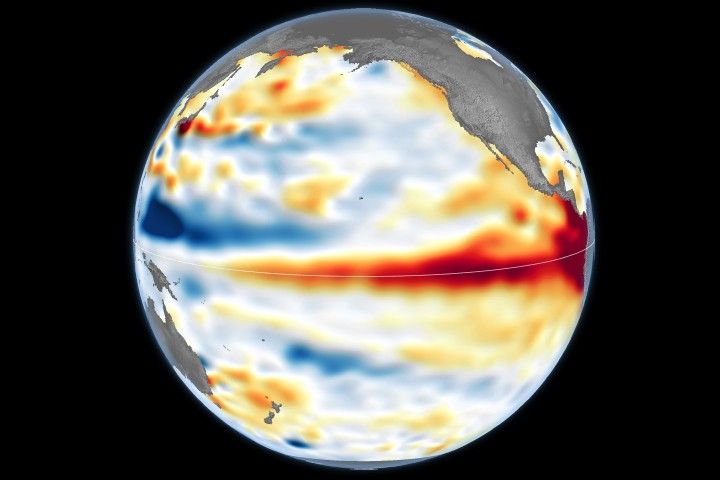
NASA is closely monitoring a climate event that is developing this fall and is described as rarer than a solar eclipse. El Niño is a natural pattern that recurs about every two to seven years and is characterized by unusually warm water in parts of the equatorial Pacific. Scientists at the agency are using satellite observations to follow how the phenomenon is taking shape. The article notes that such events can have wide-ranging effects on global weather and climate. The full report provides further details on the observations and their implications.

Read the full story at NASA

This is an AI-generated summary. ShortSingh links to the original source for the complete article.


Discussion (0)

Log in to join the discussion and vote.

Log in

Related stories

0
SpaceNASA ·

Rolling Out Solar Arrays Boosts Power for the International Space Station

The International Space Station, orbiting about 250 miles above Earth, relies heavily on the Sun as its main energy source. Solar power runs the station's life support systems, daily operations, and hundreds of research experiments. These experiments aim to benefit people on Earth and to prepare astronauts for deep space missions. Over the past five years, NASA has expanded the station's power supply through the addition of new solar arrays. The article is truncated, so further details on the specific upgrade are not included here.

0
SpaceNASA ·

NASA Plans Low-Altitude Research Flights Over Texas Farmland in October and November

NASA will fly a Dynamic Aviation A200 aircraft at low altitude over farmland near Transit, Texas, from October 22 through November 9. The flights are designed to measure gas and particulate emissions coming from animal feeding operations. Agricultural emissions are considered a significant yet poorly studied component of Earth's land and atmospheric systems. The research falls under the FarmFlux mission, which will deploy instruments to collect this data. The effort aims to improve scientific understanding of how farming activity affects the surrounding air.

0
SpaceNASA ·

NASA Funds 12 US Institutions with $12 Million for Moon and Mars Research

NASA has chosen 12 institutions across the United States to share $12 million in funding. The money is meant to speed up academic research and technology development tied to the agency's goals for exploring the Moon, Mars, and deeper space. The awards come through the M-STAR initiative, part of NASA's Minority University Research and Education Project (MUREP). Each selected institution can receive up to $1 million to support its work.

NASA Tracks Developing El Niño Pattern Forming This Fall · ShortSingh