SShortSingh.
Back to feed

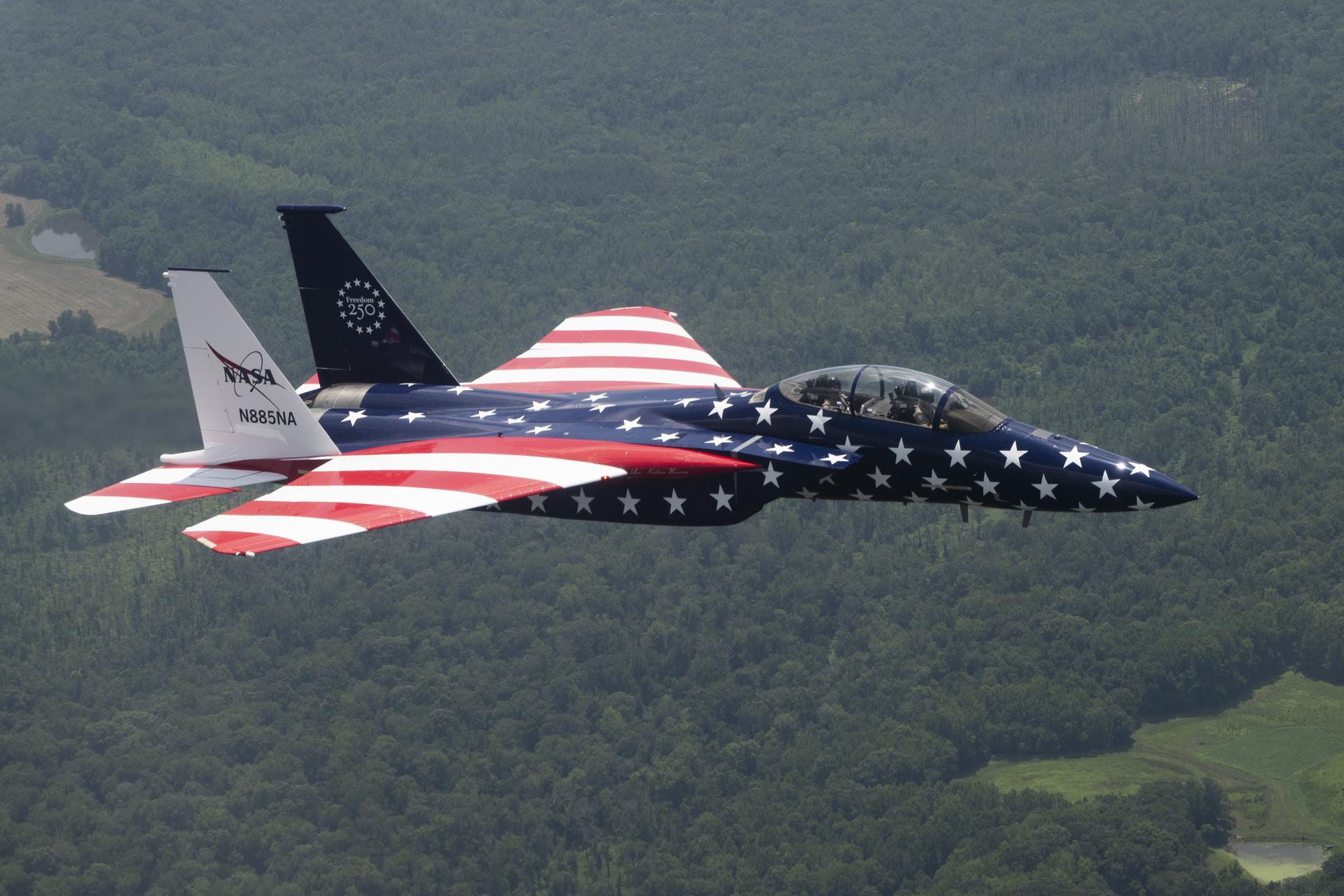
NASA Repaints Two Research Jets in Patriotic Colors for 250th Anniversary Flyover

0
·1 views

NASA has repainted two of its iconic research aircraft in red, white, and blue to mark the United States' 250th anniversary. The aircraft involved are an F-15 and an F/A-18, both based at NASA's Armstrong Flight Research Center in Edwards, California. The newly painted jets are set to participate in a flyover above Washington, D.C., on July 4, 2026. They will fly alongside other NASA aircraft as part of the Independence Day celebrations. The repainting serves as a tribute to America's semiquincentennial milestone.

Read the full story at NASA

This is an AI-generated summary. ShortSingh links to the original source for the complete article.

Discussion (0)

Log in to join the discussion and vote.

Log in

Related stories

0
SpaceNASA ·

NASA Astronaut Anil Menon and Two Cosmonauts Dock at Space Station

NASA astronaut Anil Menon and Roscosmos cosmonauts Pyotr Dubrov and Anna Kikina successfully arrived at the International Space Station on Tuesday. The crew launched aboard the Soyuz MS-29 spacecraft at 10:47 a.m. EDT from the Baikonur Cosmodrome. Their arrival temporarily expanded the ISS crew to 10 members. The three newcomers are expected to remain aboard the orbiting laboratory for approximately the next two weeks.

0
SpaceNASA ·

Hubble Captures Stellar Nursery LH 95 in the Large Magellanic Cloud

NASA's Hubble Space Telescope captured a striking new image of LH 95, a stellar nursery located in the Large Magellanic Cloud, a dwarf galaxy orbiting the Milky Way. The image, released on July 3, 2026, shows brilliant blue and white stars set against a vivid red backdrop of glowing gas. LH 95 is notable for hosting both low-mass infant stars and massive blue giant stars in close proximity. The image offers astronomers a detailed look at the early stages of star formation within a neighboring galaxy.

0
SpaceNASA ·

NASA Roman Telescope to Detect Ancient Black Holes Destroying Stars

NASA's Nancy Grace Roman Space Telescope is expected to observe supermassive black holes located at vast cosmic distances, offering a window into the early universe. Scientists aim to use these observations to understand how black holes at galactic centers form and evolve over time. The telescope will detect tidal disruption events, phenomena where black holes tear apart nearby stars, which serve as powerful indicators of black hole presence. New research highlights Roman's unique capability to spot these events far deeper into the universe than previously possible. This data could help resolve longstanding questions about the origin and growth of supermassive black holes throughout cosmic history.

0
SpaceNASA ·

NASA Image Reveals Sediment Fan Patterns Across Russia's Severny Island

A NASA image captures a striking natural formation on Russia's Severny Island in the Arctic. Sediment that has eroded from ice-capped mountains spreads out in a fan-like pattern across a wide river valley. The process is driven by glacial and mountain erosion, which carries debris downslope over time. This type of alluvial fan formation is a common geological feature in Arctic and subarctic landscapes.

NASA Repaints Two Research Jets in Patriotic Colors for 250th Anniversary Flyover · ShortSingh