SShortSingh.
Back to feed

NASA Plans Three ISS Spacewalks in August to Upgrade Solar Arrays and Systems

0
·1 views

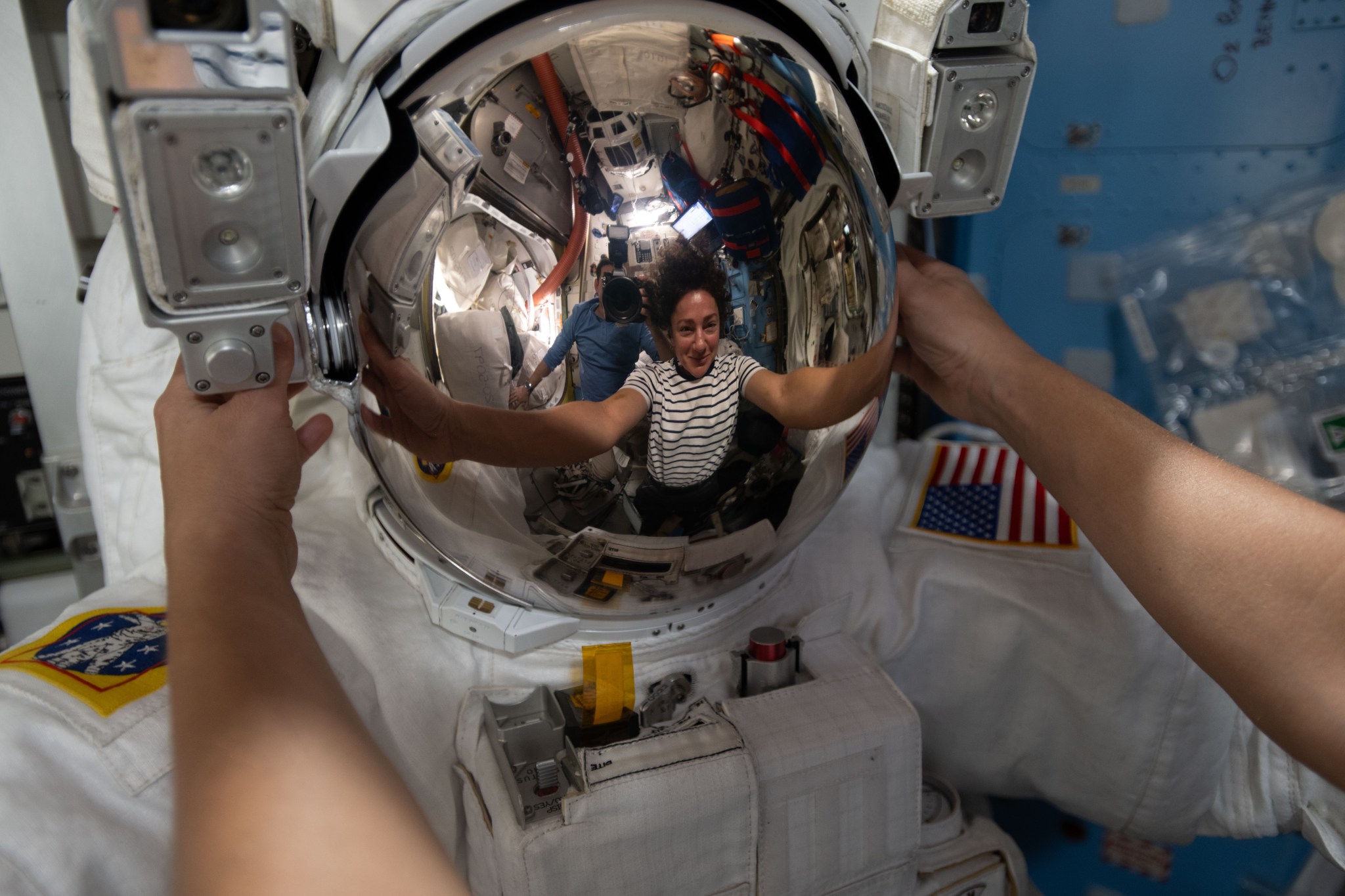
NASA astronauts are scheduled to conduct three spacewalks outside the International Space Station in August 2025. The missions will focus on upgrading solar arrays, replacing a communications antenna, and connecting power and data cables. These activities are aimed at supporting ongoing space station operations. NASA experts held a preview news conference on Thursday, July 30, at 2 p.m. EDT to brief the public ahead of the planned excursions.

Read the full story at NASA

This is an AI-generated summary. ShortSingh links to the original source for the complete article.

Discussion (0)

Log in to join the discussion and vote.

Log in

Related stories

0
SpaceNASA ·

NASA to Conduct Solar Science During August Total Eclipse Over Greenland and Iceland

A total solar eclipse will sweep over Greenland, Iceland, and surrounding regions on Wednesday, August 12, offering scientists a rare observational opportunity. During a total solar eclipse, the Moon completely blocks the Sun, temporarily darkening daytime skies and exposing the Sun's outer atmosphere, known as the corona. NASA plans to use this event to conduct scientific research aimed at better understanding the Sun and its effects on Earth. Such eclipses are considered valuable windows for solar study, as the corona is otherwise difficult to observe due to the Sun's overwhelming brightness.

0
SpaceNASA ·

NASA Astronaut Chris Williams Returns After 8-Month ISS Mission

NASA astronaut Chris Williams landed in Kazakhstan on July 26, 2026, alongside Roscosmos cosmonauts Sergey Kud-Sverchkov and Sergei Mikaev. The trio were part of the Expedition 74 crew returning from the International Space Station. This marked Williams' first spaceflight mission. During his eight months aboard the ISS, Williams contributed to a variety of scientific research projects and technology demonstrations.

0
SpaceNASA ·

NASA Captures Rare Black Hole Devouring Star Far Outside Galaxy's Core

NASA's Neil Gehrels Swift Observatory has detected an unusual event involving a wandering black hole destroying a nearby star on the fringes of a distant galaxy. The phenomenon, known as a tidal disruption event, occurs when a star passes too close to a black hole and gets torn apart. While such events have been observed before, this marks the first time one has been recorded so far from a galaxy's central region. The black hole involved is described as an 'orphan' or 'wandering' mega black hole, drifting far from its galaxy's core. Scientists had been actively searching for such star-shredding events as a method to detect and study isolated black holes in the universe.

0
SpaceNASA ·

Hubble Telescope Reveals Star Formation in Andromeda Galaxy in 500M-Year Decline

NASA's Hubble Space Telescope has uncovered evidence that star formation in the Andromeda galaxy has been steadily declining over the past 500 million years. Andromeda, the nearest large spiral galaxy to our Milky Way, appears to be gradually winding down its stellar birth activity. The findings were made possible through Hubble's powerful observational capabilities, which allow scientists to study galactic evolution in detail. This prolonged decline suggests that Andromeda may eventually cease producing new stars altogether. The discovery offers valuable insights into the life cycles of galaxies and the long-term fate of our cosmic neighborhood.

NASA Plans Three ISS Spacewalks in August to Upgrade Solar Arrays and Systems · ShortSingh