SShortSingh.
Back to feed

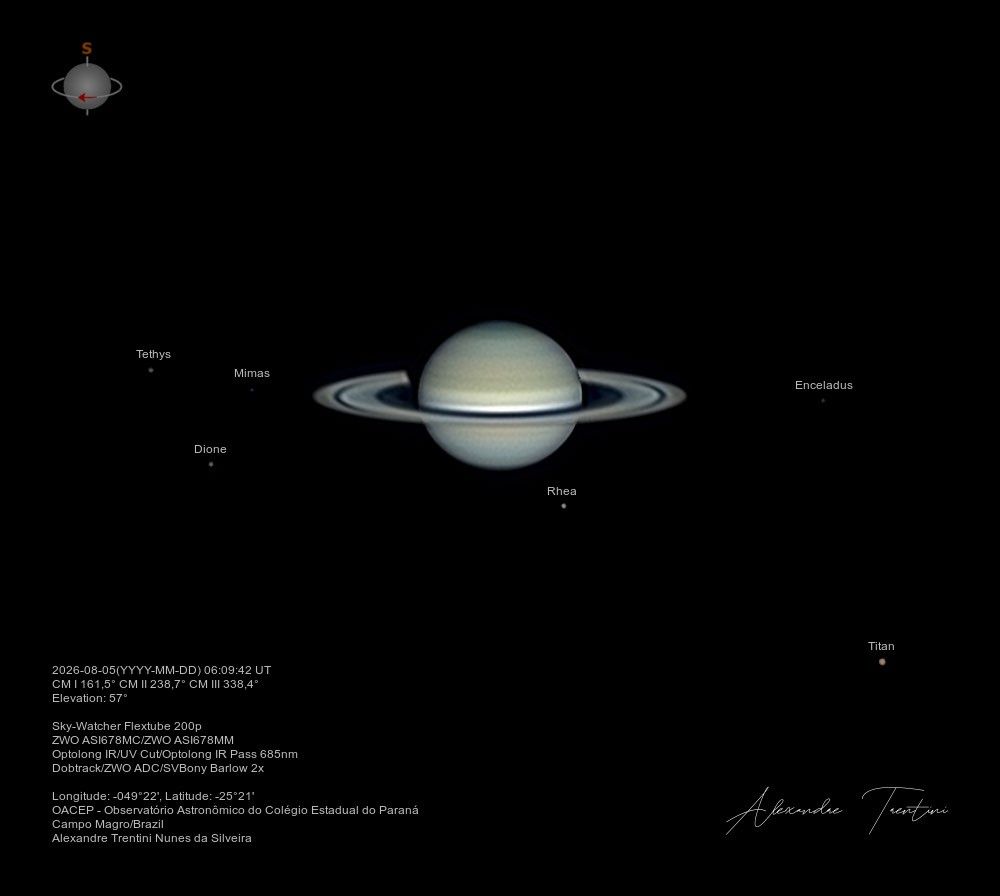
NASA APOD Showcases Six Moons of Saturn in Featured Astronomy Image
0
·3 views

NASA's Astronomy Picture of the Day (APOD) for August 11, 2026, features an image highlighting six moons of Saturn. The daily APOD program selects a notable astronomical photograph or image and pairs it with an explanation written by a professional astronomer. Saturn, the sixth planet from the Sun, is known for its extensive moon system, which includes dozens of natural satellites. The featured image draws attention to the diversity and scale of Saturn's moons within the broader context of the solar system. APOD has served as a long-running public education initiative, making complex astronomical discoveries accessible to general audiences worldwide.

Read the full story at NASA

This is an AI-generated summary. ShortSingh links to the original source for the complete article.
Discussion (0)

Log in to join the discussion and vote.

Log in

Related stories

0
SpaceNASA ·

NASA Curiosity Rover Climbs Toward Ancient Martian Erosional Supersurface

NASA's Curiosity rover is investigating a significant geological feature within Gale Crater's sedimentary record, believed to be an ancient erosional supersurface. The feature marks a past transition from a net depositional environment to an erosional one, offering clues about Mars's geological history. Planetary scientist Lucy Lim from NASA's Goddard Space Flight Center reported on the mission's progress as of July 31, 2026. The rover has been ascending toward this large-scale discontinuity to gather closer observations of the rock record. Scientists hope the data collected will shed light on the environmental shifts Mars underwent billions of years ago.

0
SpaceNASA ·

NASA Image Captures Roebuck Bay's Tidal and Seasonal Patterns in Western Australia

Roebuck Bay, a crescent-shaped bay located in the Kimberley region of Western Australia, has been captured in imagery by NASA. The bay is known for its remarkable ecological productivity, supporting diverse marine and bird life. Tidal fluctuations and seasonal changes visibly shape the bay's landscape and ecosystem over time. The imagery highlights how natural cycles leave distinct physical marks on this coastal environment.

0
SpaceNASA ·

NASA Partners with Community Colleges to Modernize Astronomy Education

Three community college instructor teams have partnered with NASA to update how astronomy is taught at the undergraduate level. The initiative aims to move beyond traditional textbook-only instruction by incorporating NASA resources, images, and interactive activities. The project reflects a broader shift toward active learning strategies that better align with how modern students engage with material. By integrating NASA's vast scientific content, educators hope to make astronomy more accessible and engaging for community college students.

0
SpaceNASA ·

NASA+ Expands to Discovery+ and HBO Max to Broaden Space Content Reach

NASA has announced that its streaming service, NASA+, is expanding to two major platforms: discovery+ and HBO Max. A continuous live feed of NASA+ programming is now available on discovery+ through its live channels section. HBO Max will carry NASA's special events, including coverage of the Artemis III lunar mission scheduled for 2027. The expansion is part of NASA's broader strategy to make space content more accessible to general audiences across popular streaming services.