SShortSingh.
Back to feed

Hubble Spots Massive 10-Sided Atmospheric Wave Around Saturn's South Pole

0
·1 views
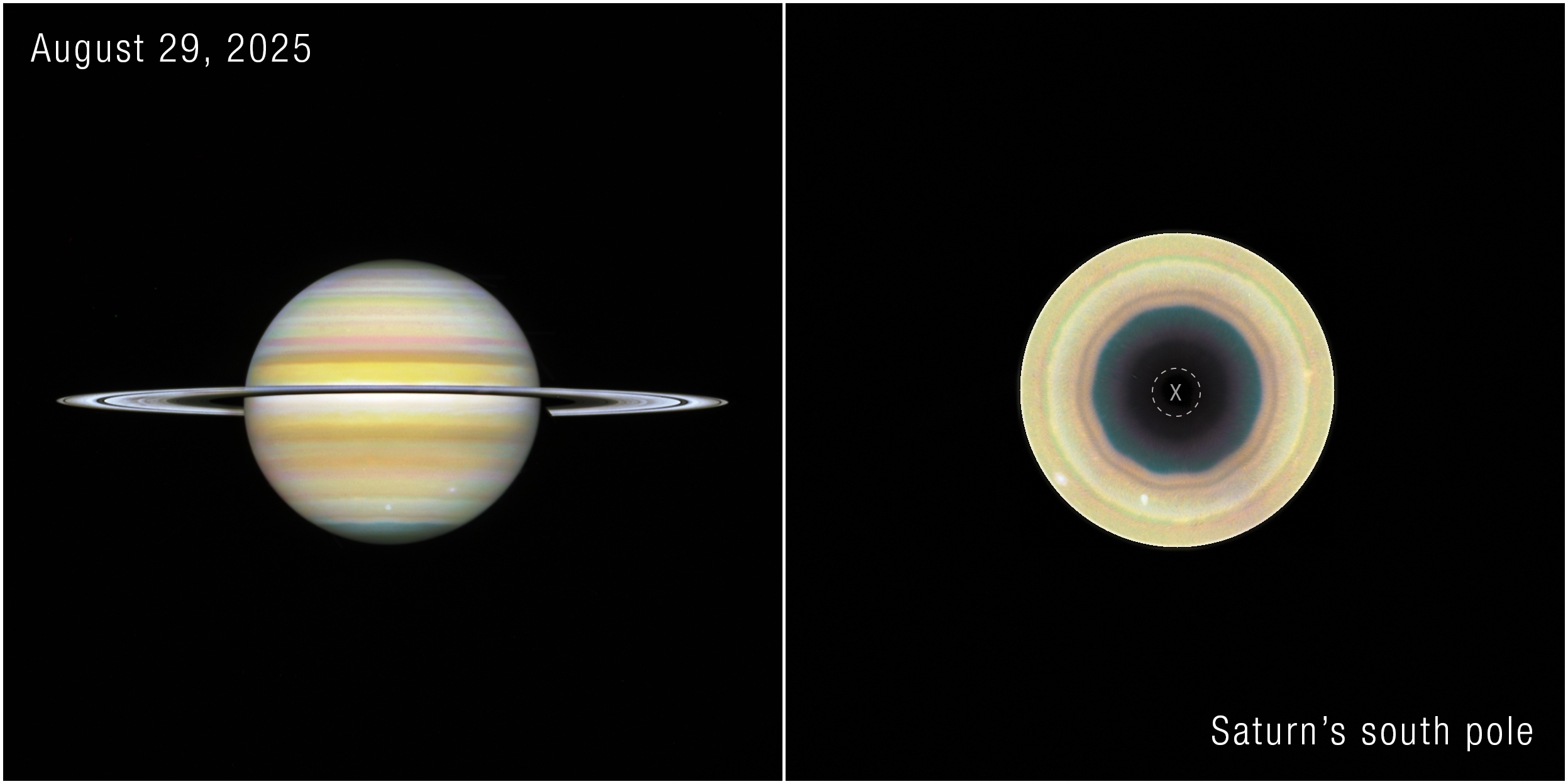
NASA's Hubble Space Telescope has detected a large, decagonal atmospheric wave forming around Saturn's south pole. The structure, which has ten distinct sides, is actively evolving over time. Scientists are using Hubble's observations to track how this unusual weather pattern develops. The discovery adds to the growing understanding of Saturn's complex and dynamic atmospheric systems.

Read the full story at NASA

This is an AI-generated summary. ShortSingh links to the original source for the complete article.


Discussion (0)

Log in to join the discussion and vote.

Log in

Related stories

0
SpaceNASA ·

NASA Revamps Community College Program to Bridge Students Into Aerospace Careers

NASA has updated its Community College Aerospace Scholars (NCAS) challenge to better connect U.S. community college students with aerospace and STEM career pathways. The revamped program invites students to learn about NASA's missions and engage directly with agency experts. It is designed to show participants how their current studies can translate into meaningful roles in science, engineering, and technology. The initiative reflects NASA's ongoing effort to broaden access to aerospace opportunities for students at two-year institutions across the country.

0
SpaceNASA ·

Deep Partial Lunar Eclipse Darkens 96% of Moon Over North America

A deep partial lunar eclipse occurred on the night of August 27–28, 2026, visible across North America and other regions. At its peak at 12:13 a.m. EDT, approximately 96.3% of the Moon's disk was submerged in Earth's umbra, the darkest portion of its shadow. The umbra is the central zone where sunlight is completely blocked, causing the Moon to appear dramatically darkened. The event was captured over Louisiana, offering striking views of the near-total phenomenon.

0
SpaceNASA ·

NASA Sounding Rocket Captures First Multi-Point Data on Sporadic E Radio Clouds

NASA has used a sounding rocket to conduct the first multi-point observation of sporadic E layers, thin metallic clouds that form near the edge of Earth's atmosphere. These high-altitude formations originate from vaporized meteor dust and are known for their unpredictable appearance and disappearance. The clouds are of scientific interest because they can disrupt radio wave transmission. The suborbital research rocket gathered new data that could help scientists better understand how and why these layers form. The findings mark a significant step forward in studying these elusive atmospheric phenomena.

0
SpaceNASA ·

NASA APOD Highlights Cultural Significance of Solar Eclipses

NASA's Astronomy Picture of the Day (APOD) for September 2, 2026 features the topic of solar eclipses and their cultural significance across human history. The daily program showcases a different astronomical image or photograph each day, accompanied by an explanation from a professional astronomer. Solar eclipses have held profound meaning for civilizations worldwide, inspiring mythology, scientific inquiry, and cultural traditions. The APOD initiative, run by NASA, aims to make astronomy accessible to the public by connecting scientific imagery with educational context.