SShortSingh.
Back to feed

GitHub and Microsoft pilot AI tool that delivers vetted fixes to open source maintainers

0
·1 views
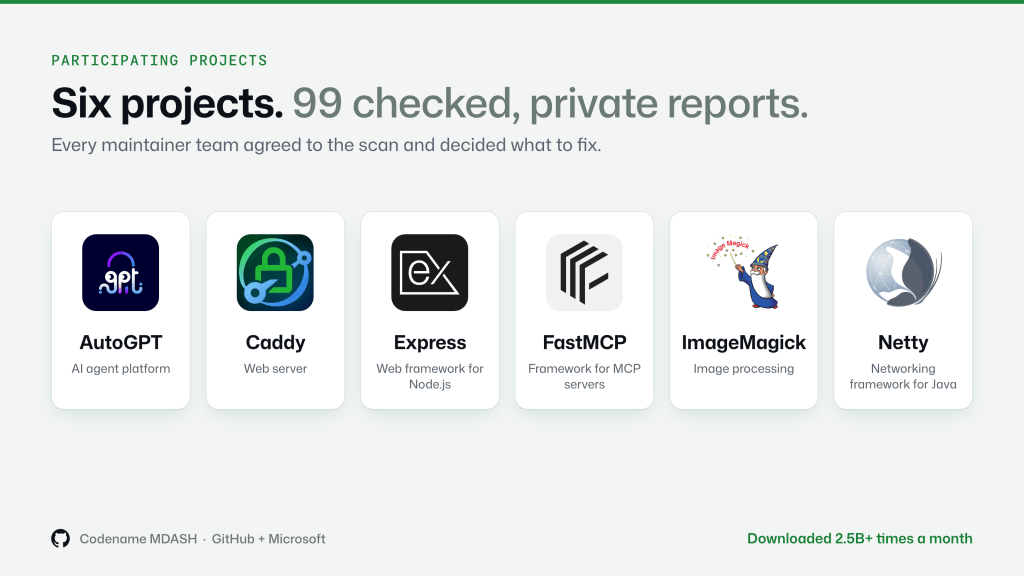
In a pilot called Codename MDASH, GitHub and Microsoft used AI to analyze open source code and sift through thousands of raw findings. The effort produced 99 verified, private bug reports, each paired with a suggested fix, for six widely used open source projects. Maintainers have already addressed more than half of these issues. The initiative focuses on delivering actionable remedies rather than simply adding more AI-generated bug reports.

Read the full story at GitHub Blog

This is an AI-generated summary. ShortSingh links to the original source for the complete article.

Discussion (0)

Log in to join the discussion and vote.

Log in

Related stories

0
ProgrammingDEV Community ·

SessionSnap: a local, account-free browser session manager for Edge and Firefox

A developer has built SessionSnap, a session manager for Edge and Firefox that saves windows and tabs as dated snapshots kept entirely on the device. The extension has no account system, sync server, or analytics, and requests only tabs, storage, and alarms permissions. Its features include scheduled auto-snapshots, flexible restore options, a log of closed tabs, search by title or URL, and import/export with Session Buddy and OneTab. Version 0.1.0 was submitted to Edge Add-ons on 2026-11-16 and is still under review, so it cannot yet be installed. The developer plans a paid Pro tier but has not started selling it.

0
ProgrammingDEV Community ·

Path Validation Must Go Beyond String Checks to Stop Symlink and Traversal Attacks

The article argues that multi-tenant applications cannot rely on lexical path checks such as Path.GetFullPath to enforce filesystem isolation. Because these methods only manipulate strings, they cannot detect symbolic links or junctions that a tenant plants to redirect access outside its workspace. The author notes that canonicalization can resolve links but remains vulnerable to time-of-check-to-time-of-use race conditions. Kernel-enforced flags such as O_NOFOLLOW are presented as the most effective safeguard, and the piece cautions that container bind mounts do not automatically prevent such escapes.

0
ProgrammingDEV Community ·

Idempotency, Not Scheduling, Governs Retry Design for Delayed SaaS Webhooks

A developer guide argues that the core challenge in retrying delayed webhooks is not choosing a scheduler but handling the ambiguous interval after a request is sent. Duplicates can occur when a receiver commits an event but the connection fails before a response returns, and no queue can detect that commit. The article recommends a database-backed queue with a stable event ID carried in headers and signed payloads, so receivers can deduplicate repeats. It also advises atomic lease claims with tokens to prevent stale workers from overwriting newer results, plus a simple state machine of pending, in_flight, delivered, and dead. The author concludes that receivers must cooperate for deduplication to work, and that without such cooperation delivery should be documented as at-least-once.

0
ProgrammingDEV Community ·

Streaming EF Core Query Results with IAsyncEnumerable to Cut Memory Use

A performance audit of reporting APIs traced erratic Gen2 garbage collection pauses to an endpoint that loaded over 50,000 transaction records into memory with ToListAsync before returning them. The buffered approach drove up heap allocations and tied up thread pool resources during JSON serialization. Switching the endpoint to return IAsyncEnumerable via AsAsyncEnumerable lets ASP.NET Core stream rows to the client as they are read from the SQL Server data reader. The author reports flatter memory usage, faster time-to-first-byte, and better concurrency under peak load. The article also cautions that mid-stream exceptions may occur after the DbContext is disposed, so middleware must handle such failures without corrupting HTTP headers.