SShortSingh.
0
TechnologyArs Technica ·

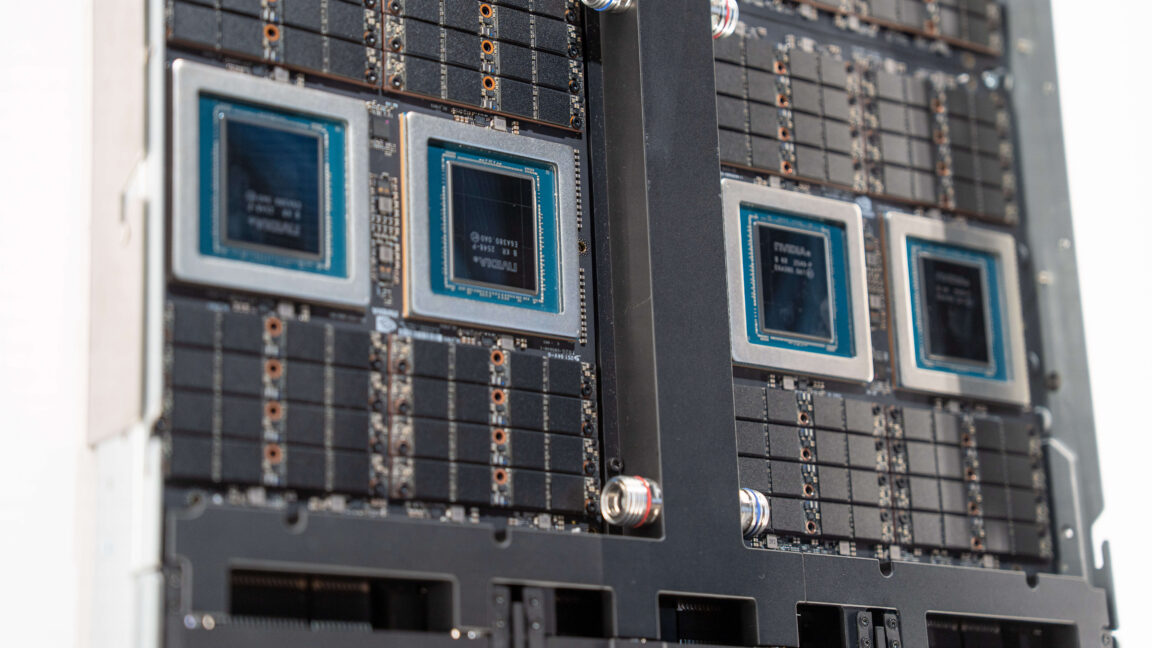
Nvidia hardware worth $11.4M disappears in transit from Oakland to Texas

Six pallets of Nvidia hardware valued at $11.4 million went missing while being shipped from Oakland to Texas. The shipment vanished en route, and the source material does not detail the exact dates or carrier involved. Two months after the disappearance, no arrests have been made in connection with the theft. The source material provides limited further detail on the investigation or how the goods were taken.
0
ProgrammingDEV Community ·

Why an 89% hallucination rate needs context: what the benchmark actually measures

A developer published a video walkthrough to explain the 89% hallucination figure, which is often cited as proof that AI models fabricate information constantly. The figure comes from a specific evaluation setup, including a defined prompt set, sampling method, and a scoring rubric that counts confident fabrication rather than hedging. The author notes that two runs with slightly different random seeds shifted the result by several points. The rubric distinguishes unsupported claims from factually wrong ones, which means a correct answer that the evaluation cannot verify can still be scored as a hit. The author also describes the cost of running the evaluation, including about 40 minutes of compute, hundreds of thousands of judging tokens, and substantial manual human review to check the rubric.

0
ProgrammingDEV Community ·

Tutorial Teaches Building Naive, Advanced and Modular RAG Systems in Python

A DEV Community tutorial walks developers through building Retrieval-Augmented Generation (RAG) systems from scratch in Python, progressing from naive to advanced and modular designs. It explains that RAG addresses LLM limitations such as hallucinations and outdated knowledge by supplying retrieved external documents as context for answers. The workflow covers chunking documents, converting them to vectors, indexing, retrieving relevant chunks, and passing them to a language model. The author uses a Spider-Man story document as a simple running example to demonstrate question answering over external data. The tutorial also covers concepts such as query rewriting, reranking, routing and query fusion, with an accompanying video.

0
ProgrammingDEV Community ·

Cursor's cloud agent can now build and deploy live apps with Postgres and SSO

Cursor's cloud agent can now scaffold a web app, provision a Postgres database when needed, place sign-in behind Cursor SSO, and host the result on a domain the user selects. The feature, called Build Live Apps, works only from cloud agents and is not available locally. Each app is hosted in an isolated account, with secrets for external systems kept hidden from the agent, and nothing goes live until automated checks and an explicit publish step pass. Cursor positions the feature mainly for internal tools, and it requires a paid plan with cloud agents enabled, starting at $30 per month on individual plans, though hosting costs are not listed in the documentation.

0
ProgrammingDEV Community ·

oh-my-claudecode Adds Multi-Agent Autopilot to Claude Code via One Command

The oh-my-claudecode plugin layers multi-agent orchestration onto Claude Code, letting users describe a feature once and have staged agents handle planning, building, and checking. Setup is done by installing the plugin from its GitHub marketplace and running a setup command, with an npm CLI route also available. The article recommends first stopping after the plan so the user can approve it before execution, and suggests a Socratic interview command to clarify vague requests. It also covers team-based execution, where multiple workers can run in parallel, noting that native teams require an experimental setting to be enabled. The author advises reviewing diffs and running tests before merging, and notes the tool may be overkill for simple single-agent tasks.

0
ProgrammingDEV Community ·

Hakeemly launches daily Arabic health Shorts made with AI tools

Hakeemly, a small Arabic health-information site, has begun publishing one Arabic YouTube Short per day, also shared as a Facebook Reel. The series, titled «ماذا يحدث لجسمك إذا…؟», explores how habits such as poor sleep, smoking, or excess salt affect the body. The videos are produced without a camera or conventional editor, using Claude Code for engineering, open models on Hugging Face for images and motion, and a script to assemble 1080×1920 clips. Each episode is checked against NHS and WHO guidance by two AI reviewers, and every video is labelled as AI-generated. The author also describes technical challenges, including limited GPU quotas and a lost video caused by terminating a process early.

0
ProgrammingDEV Community ·

Draw and Guess scoring at the 100-second default: how speed and order set each point

A draw-and-guess game built by a developer uses a 100-second round clock, with correct answers starting at 100 points plus 4 for each second remaining. Points are rounded to the nearest five, so an instant guess earns 500 and a last-second guess earns 100. Each earlier correct answer reduces what later players keep, falling to a 20 percent floor from the sixth place onward. The drawer is paid the average of the other players' speed points, with missed guesses counting as zero, and waiting for hints carries a known cost. The same proportional scoring applies to other round lengths the host may choose.

0
TechnologyThe Verge ·

Data center expansion becomes a flashpoint over power grids, bills, and local communities

Massive data centers are the physical backbone of tech companies' AI ambitions, but their rapid buildout has sparked disputes worldwide over grid strain, utility costs, and environmental effects. Data centers emerged as a bipartisan issue ahead of the 2026 midterms, and voters largely opposed expansion at the polls. OpenAI, Amazon, and other tech giants have pledged closer work with local communities and to cover their data center energy costs. After the election, Democratic leaders have called for further restrictions and slowdowns that AI companies will need to address. The Verge is tracking the ongoing coverage of these facilities and the firms building them.

0
ProgrammingDEV Community ·

OpenViking Gives Coding Agents Readable, Editable Memory Stored as Files

Coding agents such as Claude Code, Codex and Cursor normally start each session with no memory of prior project context. The open-source volcengine/OpenViking project instead stores agent context as a browsable filesystem under a viking:// address space. Each directory holds summaries at three levels of detail, so agents can scan briefly before opening full content. Committed sessions are archived and their memories saved as Markdown files that users can inspect and correct. The tool can run on a self-hosted server or a hosted service, and its README also describes using it to index code repositories and documentation.

0
ProgrammingDEV Community ·

AWS Advanced Features: What Changes When You Unlock Full Account Control

AWS's new onboarding experience gives newcomers managed defaults such as a single region, a limited service list, AWS-maintained policies, and a spending cap that can pause projects. Users can switch to full control through the "Explore advanced features" option in settings, but this requires upgrading to a paid plan first. Once enabled, the change is irreversible and the account becomes a standard AWS Organization, with the user taking over management of policies, regions, and costs. The article notes this is relief for experienced users but means beginners must now handle governance and billing risks themselves.

0
ProgrammingDEV Community ·

Iceberg, Delta Lake e Hudi: como os formatos de tabela levaram Data Lakes à arquitetura Lakehouse

Esta parte de uma série sobre Apache Spark examina a transição dos Data Lakes para a arquitetura Lakehouse. O texto explica que arquivos Parquet isolados não oferecem, por si só, transações, controle de versões ou consistência entre leituras e escritas concorrentes. Para resolver isso, formatos de tabela como Apache Iceberg, Delta Lake e Apache Hudi adicionam uma camada de gerenciamento sobre arquivos em armazenamento de objetos. Essa abordagem busca combinar a flexibilidade dos Data Lakes com recursos analíticos típicos de Data Warehouses, sem substituí-los, e permite acesso por diferentes mecanismos de SQL, BI e machine learning.

0
TechnologyArs Technica ·

Developer cancels lucrative screensaver deal with Roku after Fox acquires the platform

A developer has ended a profitable screensaver licensing arrangement with Roku because the streaming company was acquired by Fox. The developer stated that they cannot be part of the Fox ecosystem. The decision removes a lucrative revenue stream for the developer. The move reflects how corporate ownership changes can influence creators' willingness to continue business relationships.

0
ProgrammingHacker News ·

CloneGuard Tool Scans Repositories for Credential-Stealing Code Before Running

A new open-source project called CloneGuard has been shared on Hacker News, aiming to help developers inspect code repositories. The tool is designed to scan a repository for techniques commonly used to steal credentials. It is meant to be run before a cloned project is executed on a user's machine. The project is hosted on GitHub, and the discussion received a modest response on Hacker News at the time of posting. The source material provides limited detail beyond the project's purpose and links.

0
ProgrammingHacker News ·

Smaller model with Opus escalation matches Opus accuracy at a quarter of the cost

A Hacker News post highlights a setup in which a smaller model can request help from Anthropic's Opus model when needed. According to the linked Hightouch blog post, this approach achieves accuracy comparable to Opus alone while cutting cost by roughly a factor of four. The work is presented in the context of LLM judges used for identity resolution. The item drew 37 points and six comments on Hacker News. The source material is a brief community link, so the reported figures come from the linked article rather than independent verification.

0
TechnologyThe Verge ·

Shure MV7 Plus Podcast Mic Drops to $255, Nearly $50 Off

Shure's MV7 Plus, a popular USB microphone for podcasting and streaming, is currently priced at $255 at Amazon, Guitar Center, and Shure, down from its usual $299. That is only a few dollars above Amazon's all-time low for the device. A bundle with a desktop stand is available for $269 from Amazon and Shure. The MV7 Plus is an updated model featuring a USB-C port, a customizable LED light panel, and additional controls in the Motiv Mix app. It is praised for its clean audio with auto-leveling and denoising, and it offers both XLR and USB-C outputs.

0
IndiaTimes of India ·

Microsoft Ends Oracle AI Partnership, Hitting Oracle's Cloud Capacity and Shares

Microsoft has terminated its AI partnership with Oracle, reducing the utilization of Oracle's capacity. The move follows Microsoft deactivating server capacity and reviewing cloud commitments worth more than $80 billion. Oracle's expansion into AI data centers has coincided with a drop in its free cash flow. As a result, Oracle's stock has fallen by more than 50% since June.

0
ProgrammingHacker News ·

LDraw Mecha: AI agents animate LEGO mechanisms from LDraw source files

A developer has released LDraw Mecha, an open-source project that uses agentic LLMs to animate LEGO models. The tool reads specially annotated LDraw .mpd source files, infers the model's submodel structure, and identifies which parts form mechanisms. It then plans animations and executes them in Blender, producing a rigged and animated .blend file. The project follows LDraw Nova, an earlier agentic toolset for generating LEGO CAD models, and is shared on Hacker News seeking community feedback.

← NewerPage 77 of 6910Older →