0
0
Crypto & Web3CoinDesk ·
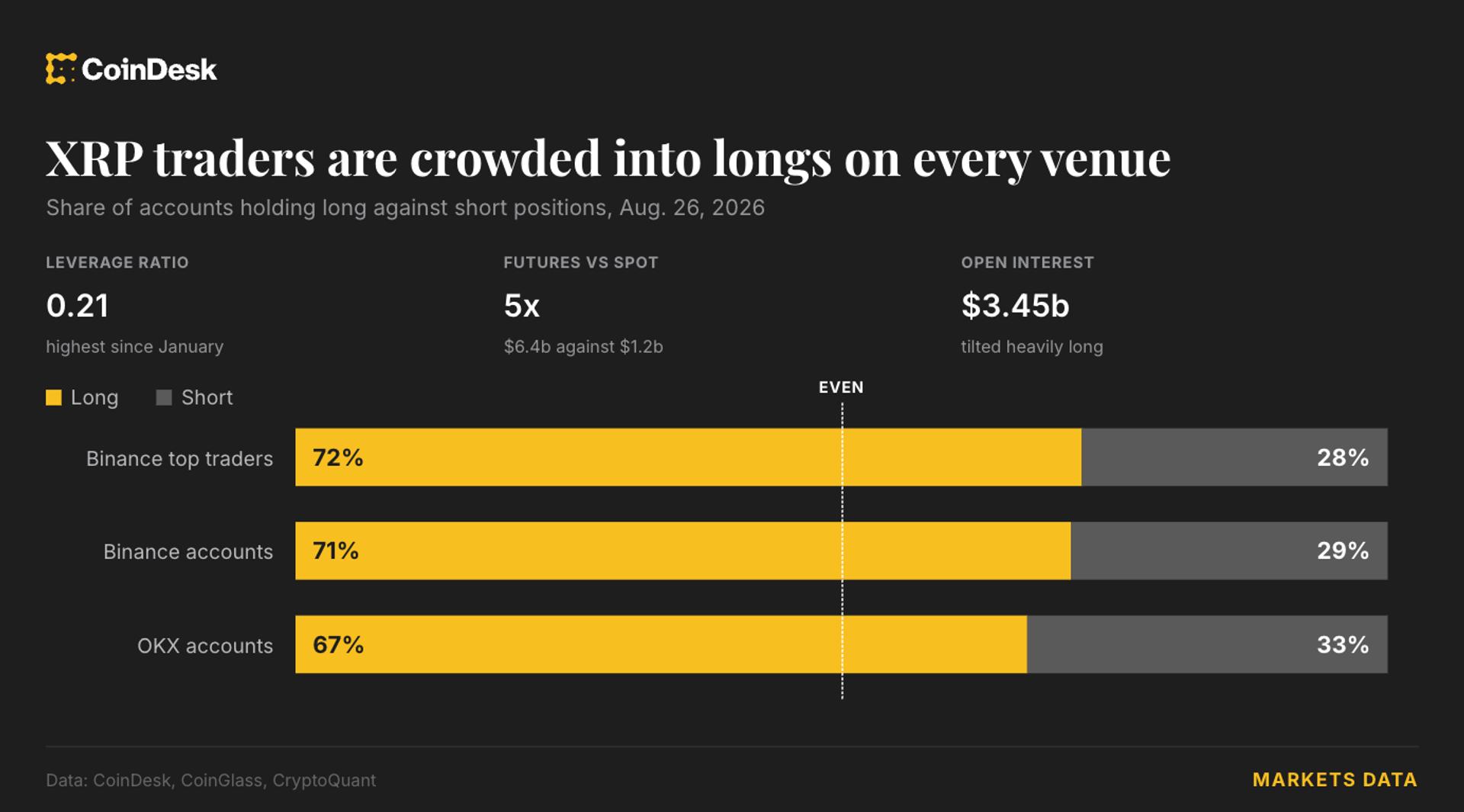
XRP's 44% Rally Drives Leverage to January Highs, Flagging Pullback Risk
XRP has surged 44% recently, drawing heightened speculative activity in derivatives markets. According to CryptoQuant data, XRP's estimated leverage ratio on Binance has climbed to its highest level since January. Long positions are currently outnumbering short positions, signaling strong bullish sentiment among traders. Futures trading volume is running at more than five times the level of spot trading, indicating elevated risk appetite. Analysts warn that such elevated leverage increases the potential for a sharper price correction if sentiment shifts.
0
ProgrammingDEV Community ·
Why 'I'll Start Later' Is a Trap: The Future Feels Easier Than It Is
A widely shared opinion piece on DEV Community argues that people consistently overestimate how much free time they will have in the future. The author explains that this happens because we experience the full weight of present responsibilities while imagining future life only through an idealized lens, free of stress and fatigue. In reality, responsibilities tend to accumulate over time rather than diminish, as school gives way to college, then work, and then broader life demands. The piece warns that delaying skill-building, such as learning to code, on the assumption that future circumstances will be more favorable is a flawed and potentially costly bet. The author urges readers to begin imperfectly today rather than wait for an ideal future moment that may never arrive.
0
ProgrammingDEV Community ·
Developer builds privacy-first Chrome extension that grades stocks with fixed rules
A developer has released StockAgent, a Chrome extension that scores stocks on a 0–5 scale using five deterministic financial metrics, including debt-to-equity ratio, RSI, and return on equity, with no AI involved in grading. News headlines from Yahoo Finance RSS feeds are also scanned for risk keywords, applying severity-based penalties to the final score. The tool offers optional email digests but is designed so that sensitive data — such as share counts, buy prices, and API keys — never leaves the user's device. To enforce this, the extension reconstructs outbound payloads from scratch using only pre-approved fields, rather than stripping private data from existing objects. A runtime validation function further blocks transmission if any forbidden field is detected, acting as a safeguard against accidental data leaks during development.
0
ProgrammingDEV Community ·
Healthcare AI Needs Forward-Deployed Engineers to Bridge Clinics and Code
Despite growing capability in building healthcare AI models, the medical field struggles to deploy them safely in real clinical settings, according to neurologist and software engineer Alireza Minagar. He argues that 'medical forward-deployed AI engineers' are needed to act as a bridge between technical teams and clinical staff, translating healthcare needs into workable system requirements. These specialists would oversee the full pipeline — from data ingestion to clinician decision-making — identifying failure points that standard technical monitoring cannot detect. Minagar also advocates for gradual deployment strategies, including silent model evaluation and mandatory kill switches to suspend AI systems when necessary. Without such human interfaces, he warns, even the most accurate AI models risk becoming clinically useless or silently unreliable once live.
0
ProgrammingDEV Community ·
systemd vs BusyBox Init: How to Choose the Right Init System for Embedded Linux
Choosing between systemd and BusyBox init is one of the earliest and hardest-to-reverse decisions in embedded Linux product development, as it shapes service dependencies, failure detection, and library requirements for the product's entire lifespan. BusyBox init is generally recommended for devices with a fixed, small set of services, offering a minimal footprint and simple configuration, while systemd suits devices needing supervised, interdependent services with features like watchdog support and resource limits. Opting for systemd comes at the cost of a significantly larger image, a minimum kernel version of 5.10, and a glibc toolchain dependency. Developers should also note that init selection and device management are separate decisions — udev rules can be used without systemd in both Yocto and Buildroot build systems. A key BusyBox init limitation is that it lacks restart back-off or start limits, meaning a failing process will loop indefinitely, paced only by a one-second sleep in the init loop.
0
IndiaTimes of India ·
Lunar Eclipse on Raksha Bandhan 2026 Won't Affect Rituals as It's Invisible in India
In 2026, Raksha Bandhan will coincide with a lunar eclipse, raising questions about whether the event would affect traditional observances. However, since the lunar eclipse will not be visible from India, the eclipse-related religious restrictions known as Sutak will not apply. Celebrants across the country can therefore proceed with the festival's customary rituals without any concern. They are advised to follow the traditional auspicious Muhurta timings for performing Rakhi ceremonies as usual.
0
IndiaNDTV ·
15 Newborns Killed in Fire After AC Compressor Blast at Pakistan Hospital
A devastating fire broke out at a hospital nursery in Pakistan on Wednesday morning after an air conditioner compressor exploded. The blaze rapidly engulfed the ward, resulting in the deaths of 15 infants. The incident has raised serious concerns about safety standards and emergency preparedness in the country's healthcare facilities. Authorities have launched an investigation into the cause of the compressor failure and the hospital's response to the emergency.

0
ProgrammingDEV Community ·
Developer Builds Self-Healing AI Knowledge System to Retain Context Across Sessions
A freelance developer has shared how he built an automated nightly pipeline to solve a core limitation of AI coding assistants: context loss between sessions. Every conversation with Claude and Codex is saved in real time and ingested each night into a structured Obsidian markdown vault, organized by project decisions, technical lessons, and open questions. The system runs on a launchd scheduler with multiple daily retry slots, making it self-healing when failures occur due to connectivity or system permission issues. By eliminating the need to re-explain prior work at the start of each session, the developer says his morning workflow begins with an already-updated brief rather than a blank slate. He credits this reduction in context overhead as a key factor behind scaling his solo freelance revenue to ¥1.2 million per month.
0
ProgrammingDEV Community ·
SP Learning Labs Releases Beginner Guide to Multi-Cloud, Community Cloud and AWS
SP Learning Labs has published a beginner-focused educational session covering key cloud computing concepts, including multi-cloud strategies and community cloud architecture. The session explains how organizations use services from multiple cloud providers simultaneously to gain flexibility, reduce vendor dependency, and access specialized tools. It also covers community clouds, which are built for groups of organizations sharing common compliance or industry-specific needs. The tutorial includes hands-on AWS demonstrations showing how to deploy a web server and manage cloud resources via the command line. The content is aimed at students, developers, and IT professionals looking to build foundational cloud skills or prepare for cloud certifications.
0
ProgrammingHacker News ·
Declassified: IBM Built a Secret Supercomputer for NSA During the Cold War
During the Cold War, IBM constructed a classified supercomputer specifically designed for a single purpose on behalf of the NSA. The machine was purpose-built for codebreaking operations, reflecting the intense intelligence demands of the era. Details about the project have only recently come to light through declassified records. The story was reported by IEEE Spectrum, shedding light on a little-known chapter of computing and espionage history.
0
ProgrammingDEV Community ·
How Your Browser Turns a URL Into a Webpage in Seconds
Every time a user enters a website address and presses Enter, the browser triggers a multi-step process to retrieve and display the page. It first contacts the Domain Name System (DNS) to translate the human-readable domain into a numeric IP address that computers can use. The browser then connects to the server at that address and sends an HTTP or HTTPS request for the desired page content. The server responds with HTML, CSS, JavaScript, and other assets, which the browser parses into structured models called the DOM and CSSOM. Finally, the browser combines these models into a render tree, calculates the layout of all visible elements, and paints the finished webpage onto the screen.
0
ProgrammingDEV Community ·
Developer Launches APIC, a Windows App to Consolidate Everyday Image Processing
A developer has released APIC (Advanced Image Processing Center), a free Windows desktop application designed to handle common image tasks — editing, converting, and compressing — within a single workspace. The tool supports a wide range of formats including PNG, JPG, WEBP, HEIC, AVIF, GIF, and TIFF. Unlike online alternatives, APIC processes all images locally on the user's machine, keeping files off third-party servers. The application uses a modular architecture that adapts its workflow based on whether one or multiple images are loaded. The developer has made a ready-to-run build available on GitHub and is actively seeking user feedback to improve the tool.
0
0
IndiaNDTV ·
Jharkhand Teen Loses Both Hands After Train Strikes Her During Reel Shoot
A 19-year-old woman in Jharkhand's Garhwa district suffered a devastating accident while filming a social media reel near a railway track. She was struck by a passing train during the incident, resulting in both her hands being severed. The young woman sustained severe injuries from the collision. The incident highlights the growing danger of filming social media content in hazardous locations near railway tracks.

0
IndiaTimes of India ·
Google Launches Gemini Enterprise for Legal to Compete with OpenAI, Anthropic
Google has introduced Gemini Enterprise for Legal, an AI-powered suite of tools aimed at streamlining workflows within law firms. The product is designed to compete directly with similar legal AI offerings from OpenAI and Anthropic. It promises seamless integration with existing legal software while placing a strong emphasis on data security. The move signals a growing push by major AI companies to establish a foothold in the legal services sector.
0
ProgrammingDEV Community ·
Manim: The Python Library That Animates Mathematical Concepts in Code
Manim is an open-source Python library that allows developers and educators to create mathematical animations programmatically, without traditional animation software. It was originally built by Grant Sanderson, known online as 3Blue1Brown, to produce the visuals for his mathematics video series. Users write Python code to define mathematical objects such as graphs, equations, and geometric shapes, and Manim handles rendering them into video. The library can be installed via pip and supports plotting real mathematical functions directly onto animated coordinate planes. Its code-driven approach means animations describe mathematical ideas at a conceptual level rather than requiring manual frame-by-frame editing.
0
ProgrammingDEV Community ·
Hygraph 2026 Pricing Explained: Free Tier Limits, Paid Plans and Upgrade Triggers
Hygraph, a headless CMS platform, structures its pricing around a mix of seat-based fees, API operation limits, and content environment counts, making costs harder to assess than typical competitors. Its free Community plan supports up to three seats and 500,000 monthly Content API operations, but field-level GraphQL counting means that limit can be exhausted faster than expected on moderately trafficked sites. The Professional plan costs $99 per month annually and adds a second environment for staging, five million API operations, and basic SLA guarantees, with extra seats billed at $15 each. The Scale tier at $499 per month unlocks five environments, 25 million operations, multi-region delivery, and Content Federation support, making it more suitable for agencies and global audiences. Enterprise pricing is unpublished but reportedly ranges from $2,000 to $8,000 per month, covering custom limits, 99.99% uptime SLA, SSO, and dedicated infrastructure options.
0
0
ProgrammingDEV Community ·
Claude Opus 5 Can Now Power Bots on Discord, Slack, Telegram and More
Anthropic launched Claude Opus 5 on July 24, 2025, positioning it as a capable model for long-running agents, coding, and professional knowledge work. The model is accessible via the Claude API using the official model ID claude-opus-5, with support for configurable effort levels and beta features like mid-conversation tool changes. An open-source framework called LangBot allows developers to connect Claude Opus 5 to multiple chat platforms — including Discord, Slack, Telegram, LINE, and WeChat — without rebuilding separate integrations for each. LangBot achieves this by keeping the AI model, conversation pipeline, and messaging platform adapter as three independent layers. This architecture lets teams test or swap models and deploy the same configuration across several channels while keeping platform credentials isolated.