0

0
0

0
IndiaTimes of India ·
Delhi to deploy Rs 1,789cr intelligent traffic system in three phases
Delhi is set to launch an Intelligent Traffic Management System worth Rs 1,789 crore to overhaul traffic flow across the city. The system will dynamically adjust signal timings based on real-time road conditions to ease congestion. Emergency vehicles like ambulances will be granted signal priority during peak hours. Automated surveillance tools will be used to detect and enforce traffic violations. The project will be rolled out in three phases, with assessments built in to ensure seamless integration and effectiveness.
0
TechnologyBBC Tech ·
Bank of England's Bailey Urges AI Safeguards Over Regulation
Bank of England Governor Andrew Bailey has argued that regulating artificial intelligence is not the most effective first step in managing its risks. Instead, Bailey called for rigorous testing and robust safeguards to contain the potential dangers posed by AI systems. His comments suggest a preference for a safety-first, technical approach rather than an immediate legislative or regulatory framework. Bailey's stance reflects a broader debate among policymakers and industry leaders about the best way to govern rapidly advancing AI technology.

0
IndiaTimes of India ·
India develops turbojet engine as Russia deploys advanced drones against Ukraine
Russia has introduced its Geran-4 and Geran-5 jet-powered drones, which pose significant challenges to Ukraine's air defense systems due to their high speed and altitude capabilities. In response, Ukraine has begun deploying F-16 fighter jets and new interceptor systems to counter these advanced threats. On a separate front, India's Defence Research and Development Organisation (DRDO) has successfully developed a turbojet engine intended for future military use. The country has also showcased its Agniveg loitering munitions, highlighting India's growing ability to strike high-value targets with precision. These developments reflect a broader global push toward more sophisticated drone and counter-drone technologies.
0
Crypto & Web3CoinDesk ·
Bitcoin Slides Below $84,000 as Markets Await Key US Inflation Data
Bitcoin fell below $84,000 as traders adopted a cautious stance ahead of the release of the PCE inflation report, the Federal Reserve's preferred measure of inflation. Markets have been on edge following a month of oil-driven speculation around potential rate hikes. This sentiment pushed 30-year US Treasury yields to their highest levels since 2002. Investors are also watching Micron's upcoming earnings report for further market direction.

0
IndiaTimes of India ·
Cabinet approves Rabi MSP hike, green energy corridor funds, and Delhi AI traffic system
The Union Cabinet has approved three significant policy measures spanning agriculture, energy, and urban infrastructure. Minimum Support Prices for Rabi crops have been raised to provide greater financial support to farmers nationwide. Funding has also been sanctioned for the Green Energy Corridor-III project, which aims to strengthen interstate transmission of renewable energy. Additionally, Delhi is set to receive an Intelligent Traffic Management System that will use real-time data to improve road safety and ease congestion.
0
ProgrammingDEV Community ·
Hybrid Search RAG Cuts Missed Retrievals by 30–40% in Internal Doc Systems
A production guide published on DEV Community details how combining vector and keyword search in a Retrieval-Augmented Generation (RAG) pipeline significantly improves retrieval accuracy over internal documents. The approach runs dense vector search (embeddings) and sparse keyword search (BM25 via Elasticsearch) in parallel, then fuses their normalized scores to surface the most relevant results. One team at LogicLoop reported a 22% improvement in MRR@10 after switching from vector-only to hybrid search on their engineering wiki, with benchmark tests across 500,000 Confluence pages and Jira tickets showing hybrid search achieving an MRR@10 of 0.50 versus 0.41 for vector-only. The tradeoff includes roughly 30ms of additional latency and doubled storage overhead from maintaining two indexes simultaneously. A notable edge case was identified for very short queries of one to two words, where keyword search tends to dominate, prompting the team to route such queries to keyword-only search via a simple length check.
0
ProgrammingDEV Community ·
Top LLM Observability Platforms for Enterprises Compared Ahead of 2026
As enterprises scale AI agents from prototypes to production, standard monitoring tools have proven inadequate for tracking the unique challenges of large language model applications. A new category of specialized LLM observability platforms has emerged to provide visibility into prompts, responses, latency, cost, and output quality. Key evaluation criteria for these platforms include end-to-end tracing, root cause analysis, data curation, and enterprise-grade security and scalability. Leading options in 2026 include Maxim AI, LangSmith, Langfuse, and Arize, each offering distinct strengths suited to different team needs and existing toolchains. The right platform choice ultimately depends on an organization's scale, technical ecosystem, and the complexity of the AI agents it deploys.

0
ProgrammingDEV Community ·
How to Connect Power BI to Local and Cloud PostgreSQL Databases via Aiven
Power BI can be connected to PostgreSQL databases both locally and via cloud-hosted services like Aiven, following a structured setup process. For local connections, users configure DBeaver with localhost credentials before linking Power BI Desktop through the Get Data option using the default port 5432. Cloud connections through Aiven require an additional SSL step, where a CA certificate downloaded from the Aiven dashboard must be imported into Windows' Trusted Root Certification Authorities. Once the certificate is successfully imported, the Aiven cloud database behaves similarly to a local connection within Power BI. After either setup, users can model data, write DAX formulas, and build live dashboards reflecting the latest database content.

0
ProgrammingDEV Community ·
How to Build Production-Ready AI Agents with FastAPI and OpenAI SDK
A developer with over a year of running AI agents in production has shared a practical guide to building them using FastAPI and the OpenAI Python SDK. The tutorial covers a minimal FastAPI setup that accepts prompts and returns OpenAI responses, handling common errors like rate limits and timeouts. It then demonstrates how to enable tool use, allowing the agent to call external functions such as internal APIs, with the OpenAI SDK managing the function-calling loop. The guide also addresses stateful agents, recommending Redis for persisting chat history and user preferences across sessions using Pydantic models. The author emphasizes avoiding manual state machine implementations in favor of letting the SDK handle the tool call and response cycle for reliability.
0
ProgrammingDEV Community ·
Power BI Basics: How Relationships, Schemas, and Joins Work Together
A beginner Power BI user shares lessons learned after struggling to connect multiple tables in their first multi-table assignment. Unlike Excel's single-sheet approach, Power BI encourages splitting data into separate tables linked by common ID columns, reducing repetition and mirroring real database design. Relationships are created in Model view by connecting shared columns, with one-to-many being the most common type. The star schema — one central fact table surrounded by dimension tables — proved simpler to manage than the more complex snowflake schema for beginner projects. In Power Query, joins like Left Outer and Inner merges allow tables to be combined before loading into the model, with Left Outer recommended as a safer default to avoid unintended data loss.
0
ProgrammingDEV Community ·
Bug in postgres-js driver causes queries to return corrupt results after timeout
A recurring crash in a backend service was traced to a bug in the postgres-js database driver, where a query result cursor was not reset after a connection error. When a query is cancelled mid-execution — typically due to a statement timeout — the row counter retains its previous value, causing the next query on that pooled connection to write results into a sparse array with empty leading slots. This produces arrays whose length exceeds the actual row count, explaining why a LIMIT 500 query appeared to return over 800 rows. The failure mode is particularly dangerous because sparse arrays do not throw errors, silently producing nulls in logs, incorrect API responses, or false 'not found' outcomes on valid records. The bug has been present in the upstream postgres-js repository for approximately a year and is difficult to reproduce locally since it requires a slow query to trigger a mid-scan timeout.
0
0
Crypto & Web3CoinDesk ·
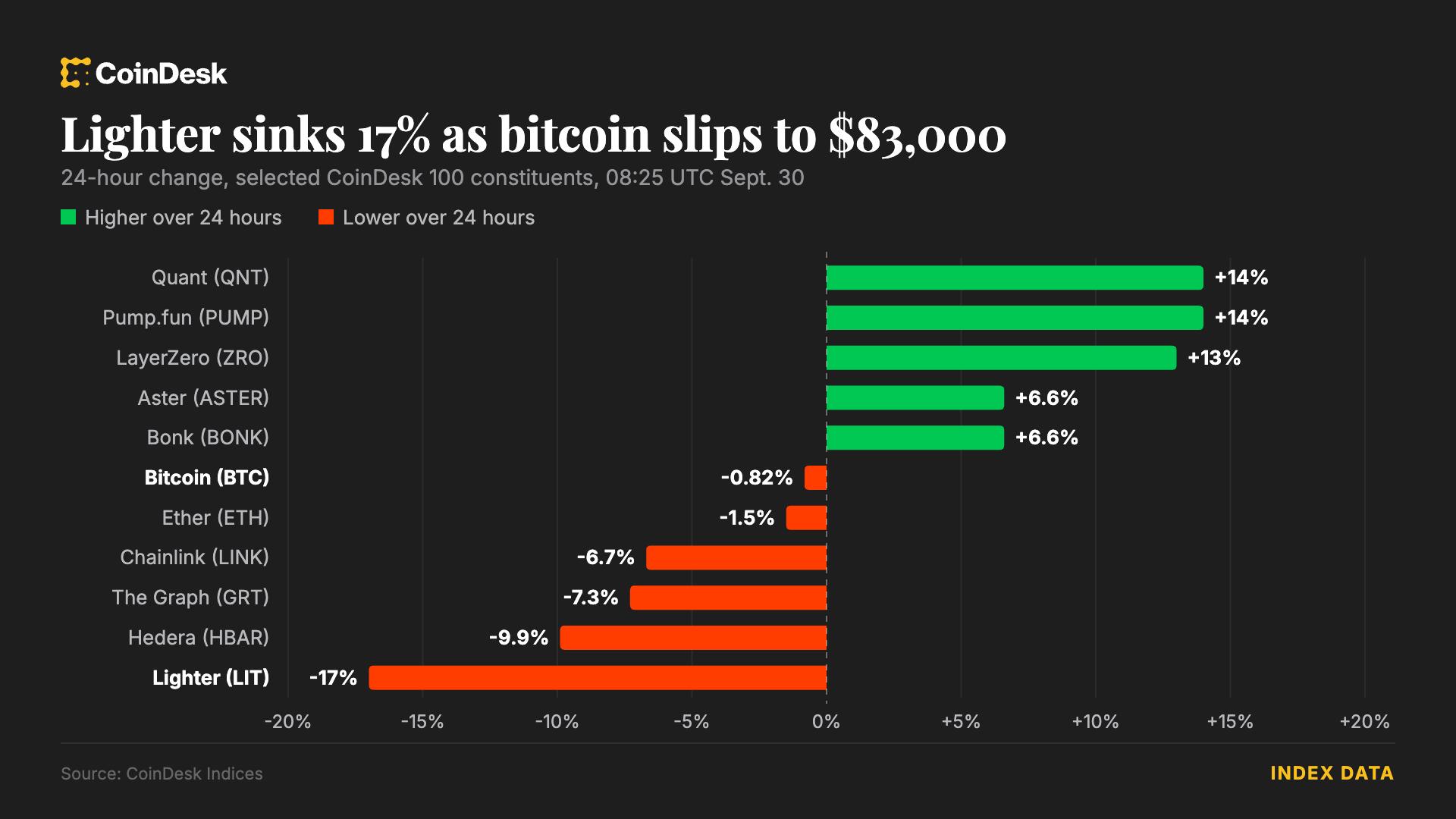
Bitcoin holds at $83K as Treasury yields surge; Lighter drops 17% on Robinhood news
Bitcoin remained steady near $83,000 even as the 30-year U.S. Treasury yield climbed above 5.6%, signaling broader macroeconomic pressure on risk assets. DeFi tokens, which had previously gained, reversed course during the same period. Lighter, a DeFi-related token, saw a sharp 17% decline following an announcement by Robinhood regarding plans to launch perpetual futures trading in the United States. The Robinhood perpetuals offering is seen as direct competition to existing decentralized derivatives platforms like Lighter. The developments highlight how traditional finance entrants continue to influence sentiment and pricing across the crypto market.
0
ProgrammingDEV Community ·
How a 20-for-1 Stock Split Made Amazon Look Like It Crashed 95%
Raw price data from Amazon's trading history appeared to show a catastrophic 94.9% single-day drop on June 6, 2022, but the move was not a real loss in value. The apparent collapse was caused by Amazon's 20-for-1 stock split executed that day, which divided each share into twenty smaller shares at one-twentieth the price. While the raw closing price fell from $2,447 to $124.79, the adjusted closing price actually showed a modest 2.0% gain over the same period. The discrepancy highlights a common data pitfall: raw price columns record exact trade prices, while adjusted close retroactively rewrites historical prices to account for splits and dividends. Analysts are cautioned that neither column is universally correct, and using the wrong one in calculations such as return models or backtests can produce severely misleading results.
0
ProgrammingDEV Community ·
Background Jobs Must Re-Authorize at Runtime, Not Just at Enqueue Time
Async background jobs commonly inherit user IDs, tenant IDs, or token snapshots from the original request that scheduled them. However, these snapshots do not constitute a permanent permission grant, as roles, memberships, or resource access may change before the job actually executes. A worker that relies solely on enqueue-time credentials risks acting with privileges the user no longer holds. Developers should re-authorize each job against the current subject, tenant, and action immediately before any sensitive read or write operation. The enqueue-time check should only determine what can be scheduled, while final authorization must occur at the actual moment of data access.
0
0
ProgrammingDEV Community ·
A 40-Line Python Script Can Detect AI Text, But Its Failures Reveal More Than Its Wins
A developer built a compact 40-line Python AI-text detector using two signals: sentence-length burstiness and repeated n-grams, with AI-generated text typically scoring lower due to uniform structure and repetitive phrasing. The tool works as a quick triage filter but breaks down in three notable ways identified during real-world use. Short texts under roughly 40 words produce unreliable scores, while naturally uniform genres like legal writing or API documentation are wrongly flagged as AI-generated. The detector is also trivially easy to game, as minor edits such as splitting sentences or swapping synonyms can reset the score without improving actual prose quality. The author concludes that such a detector serves only as a smoke test, not a reliable judge of writing quality or human authorship.